Future of Work
Turning new AI capabilities into real business value is where the actual work begins now.
I was recently challenged with the question: if people are already adopting AI, what does change leadership actually add?
The numbers support the challenge. AI use has become widespread. McKinsey’s latest global survey found that 88% of organizations report regular AI use in at least one business function. Deloitte found that two-thirds of organizations, 66%, report productivity and efficiency gains from AI.
Change leadership is judged by the goals an organization actually reaches. Adoption is just one step along the way. If adoption is climbing and productivity is rising, why are so few companies seeing real financial results? BCG’s most recent research found that only 5% of companies are generating measurable AI value at scale, while 60% report no material value at all.

That gap tells me we’ve been measuring the wrong finish line.
Adoption tells us people are using AI. ROI tells us whether the organization became more valuable because they did. Efficiency created and value captured are two very different outcomes, and most organizations are only tracking the first one.
If AI is being used and employees are becoming more productive, where is the value actually going?
AI Creates Capacity. Capturing It Is a Separate Job.
Picture someone who used to spend eight hours producing a report. AI now helps them finish it in three. Five hours just opened up.
Those five hours are potential value. They aren’t ROI yet.
Without a goal already in place for that time, what fills the time saved? Do those five hours go toward customers? Innovation? Better decisions? New revenue? Building new capability? Or does another meeting simply appear on the calendar to fill the space?
BCG found that 42% of regular frontline AI users save at least eight hours a week, essentially an entire workday. And yet, 66% of those employees say they get little or no guidance on where that time should go.
The capacity is real. What organizations do with it is still an open question.
Where is that day going?
We Never Decided What Value AI Was Supposed to Create
Most organizations start with the wrong question: How can we use AI?
A better starting point asks three things instead. What are we trying to achieve? What’s possible today that wasn’t possible before? What does our organization need to become capable of next?
AI has to connect to a business outcome the organization can actually name: revenue, margin, productivity, or innovation.
Efficiency is a given at this point. Every competitor can chase the same cost savings, which turns pure cost-cutting into a race to the bottom. The real question is what return the AI investment actually produces beyond the efficiency it delivers.
Here’s a diagnostic question worth asking before you look at any usage dashboard. What measurable business outcome was this AI investment supposed to change? If your executive team can’t answer that quickly, you already have a value leak.

We Skipped the Baseline
Before deciding what to implement, the better process starts by listening across the organization, identifying key workflows, and understanding their current state before deciding where AI could free up capacity.
That groundwork matters because “AI made us faster” isn’t a measurement. Faster than what? By how much? At what cost? Producing what, and at what level of quality?
The real measurement chain runs like this: baseline, AI intervention, efficiency created, capacity created, capacity redirected, business result. Skip the baseline and every step after it becomes a guess.
We Made Today’s Work Faster Instead of Questioning Tomorrow’s Work
There’s a bigger question hiding behind most AI rollouts. What’s possible now that wasn’t possible before?
Most organizations only ask how AI can make an existing process faster. Few ask whether that process would even exist in its current form if they were designing the work today, knowing what AI can do.
Deloitte found that only 30% of organizations are redesigning key processes around AI, while another 37% are using AI with little or no process change at all. McKinsey found something even more telling. Out of 25 organizational attributes it tested, workflow redesign had the strongest relationship with EBIT impact of any factor measured.
That’s a real opportunity most companies are leaving on the table. The biggest ROI often doesn’t live inside the existing workflow. It lives in realizing the existing workflow doesn’t need to exist at all.
We Trained People on AI Without Building the Conditions to Use It
I’ve spoken with a number of leaders whose teams already have AI training in place. They describe their people as stuck. People know the tools but struggle to find time to apply what they’ve learned, and many still need significant hand-holding to actually use AI in their day-to-day roles.
Having access to a tool, using that tool, building real skill with it, and creating measurable value from it are four separate milestones. Getting through one doesn’t guarantee the next.
That’s exactly the kind of friction leaders need to look for. The training exists. Leadership supports the initiative. Employees have access. And something is still standing between the training and changed behavior.

Their stories reminded me of my own experience early in my recruiting career, when a new database was introduced. At first it felt like extra work, because I was maintaining my old system while also learning the new one. My habits changed the moment I saw coworkers using the database to land placements I was missing. People don’t resist new tools out of stubbornness. They resist them when the new tool creates more work before it creates any visible benefit, and that’s happening with AI right now.
Here’s a hypothetical worth running with your own team. Suppose AI removes 30% of a workflow. What do you want people doing instead? The capacity that opens up could go toward better customer experiences, new products, sharper decisions, more time with designers, real experimentation, or genuine innovation. If you don’t decide where that capacity should go, don’t expect to find it on the P&L.
We Treated AI Transformation as a Technology Problem
Capturing AI value takes four capabilities working together, not one capability working alone.
Business. Can AI produce revenue, margin, productivity, or innovation? This depends on naming the outcome up front.
Technology. Do we have the tools, data, and governance this requires? This depends on infrastructure.
Human. Do people understand how their value is changing, and do they have the confidence to work differently? This depends on skills and judgment.
Organizational. Can leaders create room for experimentation and let decisions move across functions? This depends on workflow redesign and leadership.
Technology capability alone can’t answer the human and organizational questions. An organization doesn’t capture meaningful AI ROI by maximizing just one of these four. They have to move together.
The Missing Variable Is Friction
Back to the original challenge. If people are already adopting AI, what does change leadership add?
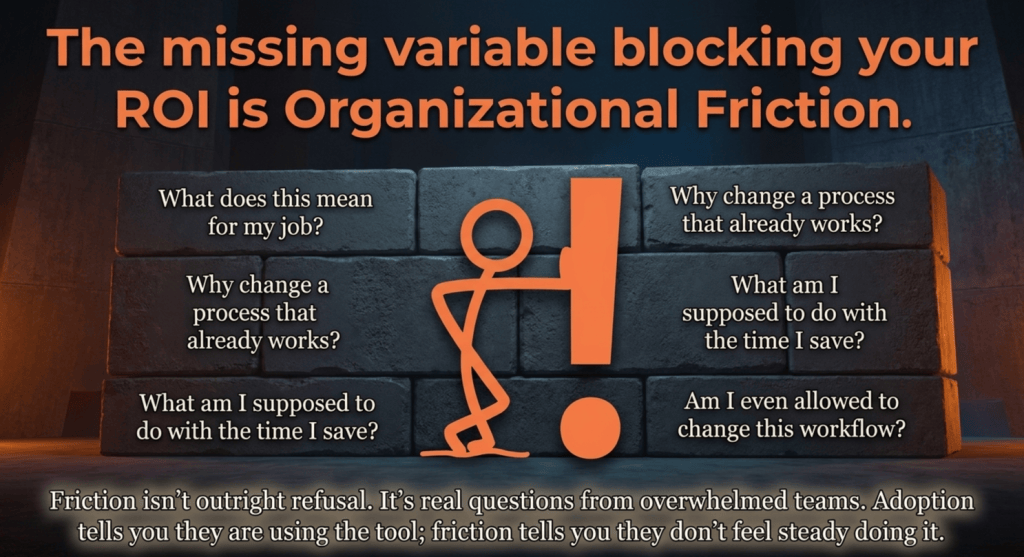
Change leadership adds the ability to see and work with friction, the thing adoption alone can’t touch. Adoption measures whether people are using a tool. It says nothing about whether they feel steady doing it, whether they understand what it means for their role, or whether anyone has told them what to do with the time or judgment AI frees up. That gap is where the friction lives, and it’s exactly the terrain change leadership is built to work.
The leaders I’ve spoken with described that friction in concrete terms. AI shows up as something added on top of everything their teams already do, rather than something that replaces or simplifies existing work. It doesn’t feel like it’s in their control. The weight of getting a whole team AI-ready tends to land on a handful of leaders, who are being asked to make that happen without the time or capacity to do it well.
Friction rarely sounds like outright refusal. It sounds like real questions. When am I supposed to do this? What does this mean for my job? Why change a process that already works? What am I supposed to do with the time I save? Am I even allowed to change this workflow? Who decides?
AI also introduces something most previous technology rollouts didn’t carry at the same scale. Some employees have genuine moral objections to the technology itself, and leaders can’t simply wave those concerns away.
So Where Did Your AI ROI Go?
Run your own organization through these eight questions, and notice exactly where your answers get thin.
1. Intended value. What measurable business outcome were we trying to create?
2. Baseline. What did the work cost, require, and produce before AI?
3. Capability created. What can people or the organization do now that wasn’t possible before?
4. Workflow changed. Did we redesign the work, or just make the existing process faster?
5. Capacity redirected. What are people actually doing with the time AI created?
6. Workforce capability. Have we developed people for the higher-value work we now expect from them?
7. Organizational friction. What’s preventing people from changing how the work actually happens?
8. Business result. Where can we point to the result in revenue, margin, productivity, innovation, or customer value?

Ask this at each step: at which point does your evidence disappear? That’s probably where your AI ROI went.
Adoption Is Where the Transformation Starts
People are adopting AI. That’s genuinely good news. It means this change stopped being theoretical.
Jobs are changing. Workflows are changing. Expectations are changing. Capacity, skill requirements, and decision-making are all changing right along with them.
Adoption doesn’t reduce the need for change leadership. It’s exactly when the real work starts, because the goal was never to get people to use AI. The goal was, and still is, to build a more capable organization because AI exists.
Oh, and one more thing. If this got you thinking about how your own organization handles change, my book, Learn to Love the Roller Coaster, digs into exactly that. It’s built from real stories of people who have navigated change in their own lives, paired with frameworks that make the ride more enjoyable.