Change Management
When a company cuts ten roles and justifies it with AI efficiency gains, the math looks clean on a spreadsheet. Payroll drops, output holds steady, and the P&L looks better than it did last quarter. What doesn’t show up on that spreadsheet is where the time savings actually went, who is carrying the extra load, and whether any of it is moving the business forward. Reducing headcount and adding expectations onto the people who remain isn’t a growth strategy. It’s a way to look efficient while drift sets in.
The problem isn’t the technology. It’s what happens to the time it creates.
The Savings Are Real. The Gains Aren’t Showing Up.
The time savings from AI aren’t theoretical anymore. Knowledge workers using AI tools report saving between 40 and 60 minutes per workday, according to OpenAI’s 2025 enterprise data, with roles in data, engineering, and communications saving closer to 80 minutes daily. Federal Reserve research found that among workers using AI regularly, one in three daily users saves four or more hours every week.
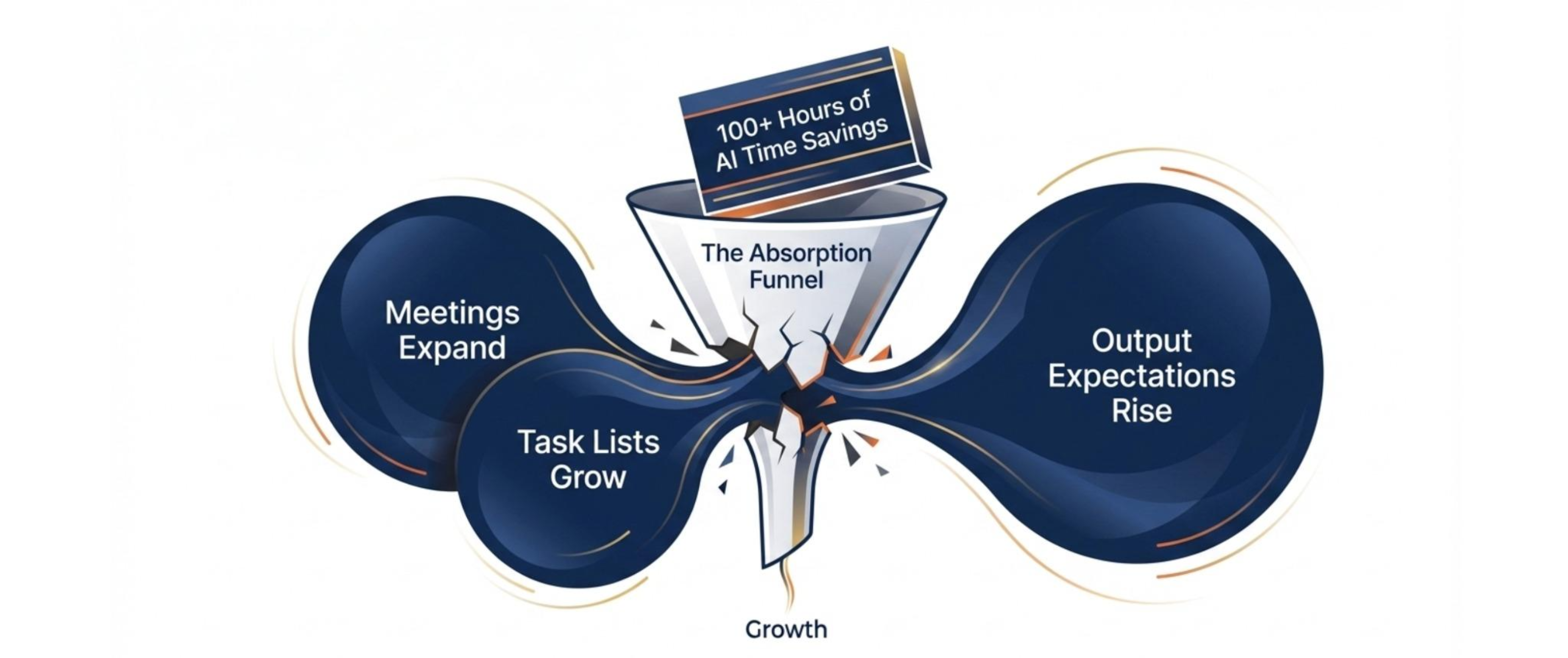
Do the math on your own organization. A fifty-person team where half the people are regular AI users, a conservative estimate for a high-growth company in 2025, could be generating a hundred or more hours of additional capacity every week. That’s the equivalent of two or three full-time roles, created without adding headcount.

Most leadership teams can’t tell you where that time goes.
It gets absorbed. Perhaps in more meetings, an expanding task list, or oftentimes in anxious, busy work as a means to protect a job. Output expectations rise to meet the new pace. The organization becomes more efficient at doing what it was already doing. However, no one becomes smarter about what should be done differently.
Efficiency creates capacity, but capacity without direction disappears.
Speed Without Thinking Is Just Faster Drift
Harvard Business Review has found that 67% of well-formulated strategies fail not because the strategy was wrong, but because execution drifted away from it. A separate study found that 68% of leaders believe their own teams aren’t fully aligned with the organization’s strategic direction.
That misalignment has a specific cause. When people are under constant pressure and moving fast, they default to what’s familiar. They optimize what’s in front of them. They solve the problem that’s loudest, not necessarily the one that matters most.

AI doesn’t fix this. In fact, it accelerates it. More output comes faster, in whatever direction the team is already pointed.
What most leadership teams are missing isn’t better strategy at the top. It’s better signal from the bottom. The people closest to the work already know where the problems are. They just don’t have the time or the invitation to say so. The missing ingredient isn’t more efficiency. It’s deliberate space for bottom-up thinking, where teams can surface the right problems before leadership commits to solving the wrong ones. That’s where the time savings should go.
What It Looks Like When the Time Actually Works
The difference between companies gaining market share and those just moving faster shows up not in their tools, but in how their leaders use recovered time.
A VP of Sales who saves eight hours a week from AI-assisted pipeline reporting spends two of those hours in conversations she wasn’t having before, sitting with her highest-potential reps and digging into why certain deals are stalling at the same stage. The next quarter, close rates on mid-market accounts move.
A product team that cuts its weekly update process from six hours to two doesn’t schedule more standups. It creates a standing ninety-minute session where anyone can bring a problem they’ve been too underwater to name. Three months in, they catch a customer retention issue before it shows up in the churn data.
A leadership team that stops drowning in prep work doesn’t fill the space with more deliverables. It uses a monthly half-day to pressure-test its assumptions, asking which initiatives are producing real results and which are producing the appearance of results. Decisions get sharper. Priorities stop shifting every six weeks.
None of this is complicated. It’s intentional.

The Question Leaders Need to Answer Now
AI is already creating the time. The question is what it’s being used for, and most leadership teams don’t have a clear answer yet. That’s not a technology problem. It’s an organizational design problem, and it’s exactly where high-growth companies lose ground without realizing it.
The leaders who get this right aren’t just adopting AI tools. They’re making deliberate decisions about how recovered capacity gets reinvested, where thinking time gets protected, and how their teams stay aligned around the problems that actually matter. That kind of intentional design doesn’t happen by accident, and it doesn’t happen by moving faster.
This is the work I do with leadership teams navigating exactly this moment. If you want to think through where your organization stands, subscribe to this newsletter. I share insights like this every Sunday and practical tools every Wednesday in my newsletter, so there’s always something actionable waiting for you at the start of the week and the middle of it. And if you’re ready to have a direct conversation about what this looks like inside your organization, I’d welcome that too.