Change Management
Most people are already in the middle of something. A new initiative, a technology decision, a restructuring, or a shift in priorities is already underway.
A decision that has been discussed but not yet finalized. A plan that exists in draft form. A shift that started quietly and is now shaping priorities and conversations.
Change rarely arrives with a clear starting point. More often, it emerges gradually through accumulated signals, pressures, and small decisions that begin to align. By the time change is formally named, much of its direction has already been set.
That is why many outcomes attributed to execution are actually determined much earlier.
Being in Motion Is Not the Same as Being Oriented
Once momentum builds, movement can feel reassuring. Progress appears to be happening. Plans are advancing. Timelines are forming.
But movement alone does not guarantee clarity.
Without orientation, teams can move quickly toward goals that are poorly defined or no longer relevant. They may respond to symptoms rather than underlying causes, or optimize one area of the organization while creating strain in another.
Stepping back at this stage is not about slowing down. It is about understanding what is truly driving the change.
What conditions have shifted? What assumptions are still being treated as fixed? What problem is this effort actually intended to solve?
Taking time to answer these questions creates alignment. It helps leaders distinguish between urgency and importance. It also reduces the likelihood that execution will need to be revisited or corrected later.
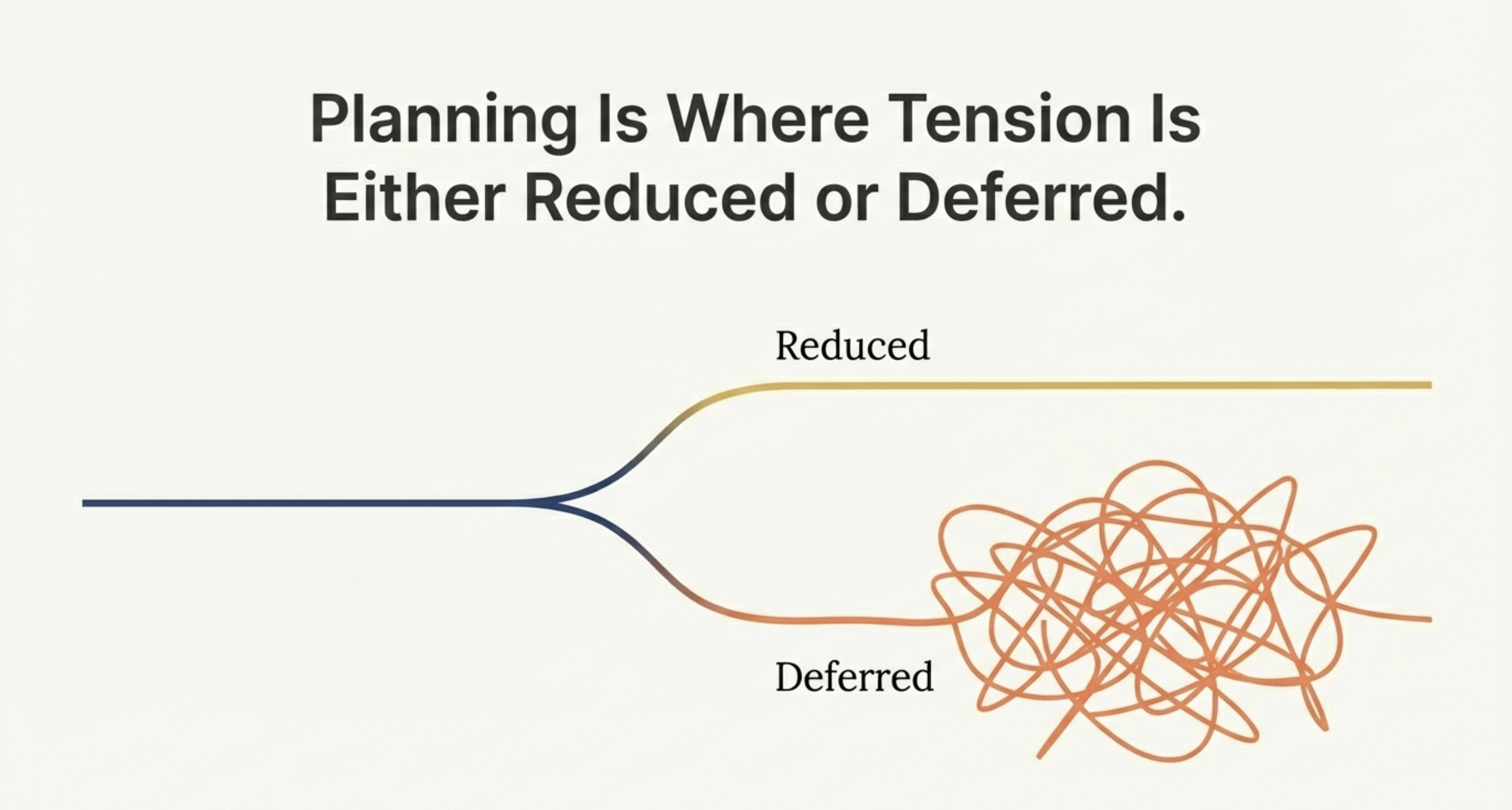
Planning Is Where Tension Is Either Reduced or Deferred
Planning is often treated as a technical exercise. Define the scope. Set milestones. Assign ownership.
In reality, planning is where the human and systemic dimensions of change begin to surface.
This is the stage where leaders decide whose perspectives are included and whose are not. It is where tradeoffs are acknowledged or ignored. It is where downstream impacts are anticipated or left to emerge on their own.
When input is gathered early, planning becomes a way to surface friction before it hardens into resistance. Dependencies become visible. Concerns can be addressed while there is still flexibility. Trust is built through participation rather than persuasion.
When this step is skipped or rushed, tension does not disappear. It simply shows up later, often during execution, when the cost of adjustment is higher and options are more limited.
A Natural Progression
Effective change tends to follow a steady progression.
First, there is a clear understanding of the present state. Not an idealized version, but an accurate one.
Next comes assessment. What has shifted? What does that change affect across systems, teams, and priorities?
Only then does transition make sense. This is where decisions are translated into action with intention rather than urgency.
Finally, the change is fully harnessed. New ways of working are integrated. Lessons are absorbed. The organization adapts rather than just reacts.
When this progression is compressed, the burden often falls on execution to compensate. Teams are asked to move faster, absorb ambiguity, or correct course midstream.
Why This Matters Now
In environments defined by constant change, planning can no longer be a one-time event that precedes action and then disappears.
It has become an ongoing discipline. A way of maintaining orientation as conditions evolve.
This does not mean slowing everything down. It means being deliberate about where clarity is required before momentum increases.
Not every decision needs extended analysis. But the decisions that shape direction, capacity, and trust benefit from early attention.
That is often where durable change begins.
Already in the middle of change? Take a short assessment to check planning-stage clarity before moving further.