
Change Management
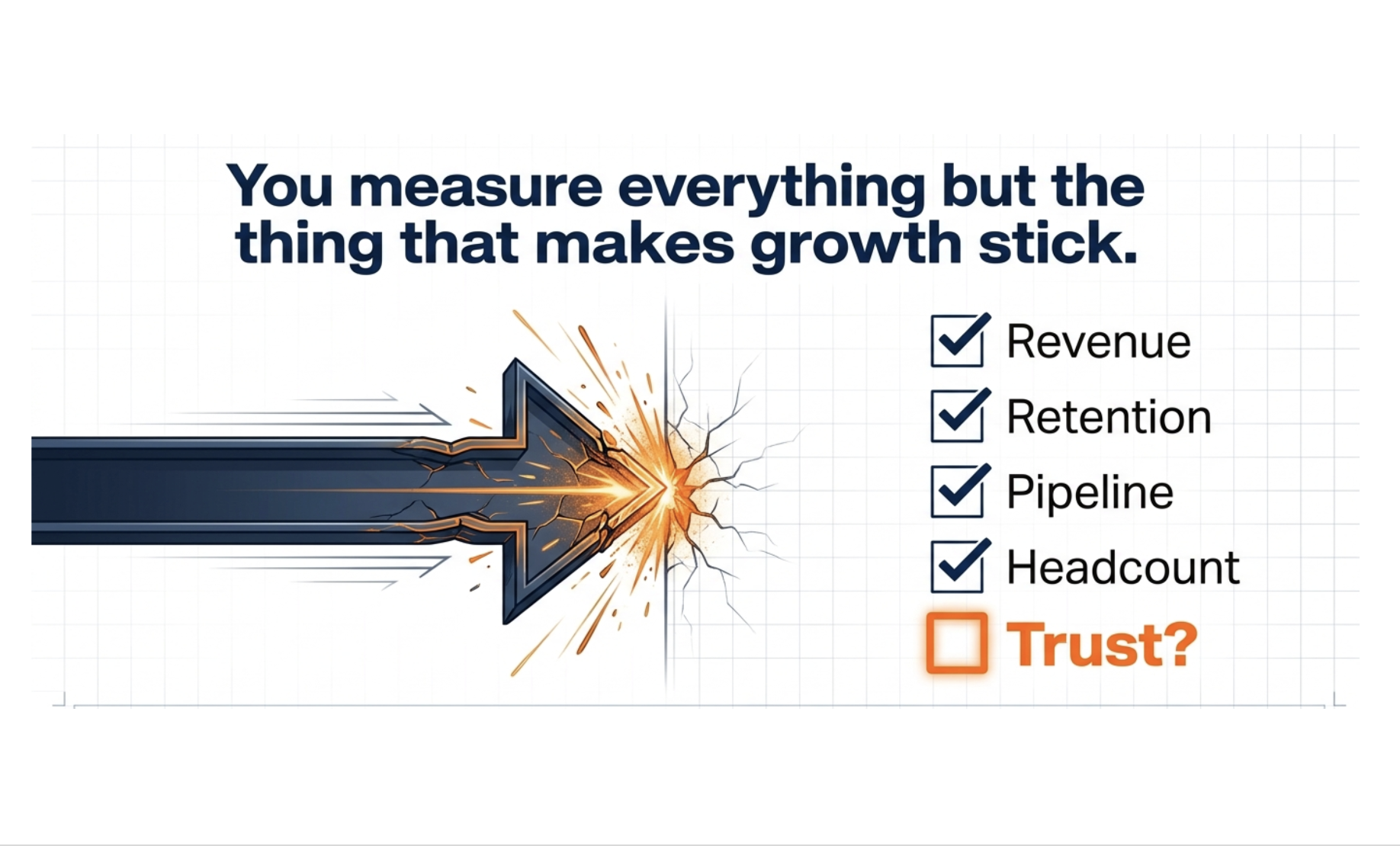
Most high-growth companies are measuring everything except the thing that determines whether growth actually sticks. Revenue, retention, pipeline, headcount. But not trust. Trust doesn’t show up in a dashboard. It shows up in hesitation, delays, and the moments when people stop raising their hand.
Recent data reflects this tension. According to Edelman’s Trust Barometer, nearly 8 in 10 employees globally say they trust their employer. But when the focus shifts to leadership, the numbers change significantly. Gallup found that only 23% of U.S. employees strongly agree that they trust their organization’s leadership. And Gartner research adds another layer: in 2016, 74% of employees were willing to change their behavior to support organizational transformation. By 2023, that number had dropped to 43%.

This gap is more than a perception issue. It directly impacts execution.
Employees may trust the company as an institution, but during periods of change, are they following the people leading them through uncertainty?
When Trust Can’t Keep Up With Growth
In stable environments, this distinction is easy to overlook. If work gets completed, the processes remain consistent, and teams generally understand expectations.
Growth changes that dynamic.
High-growth companies introduce speed, complexity, and constant change at the same time. Decisions are made faster than they can be fully explained. Priorities shift before previous initiatives have time to stabilize. New layers of management are introduced while roles and responsibilities are still evolving.
In this environment, trust becomes visible as an operational factor.
When trust is strong, teams move forward even when they do not have complete information. People raise issues early, collaborate across functions, and managers reinforce direction with confidence. Execution feels coordinated and intentional.
When trust is fragile, the same organization begins to slow down. People hesitate before committing to decisions. Teams second-guess priorities. Managers interpret direction differently based on their own level of confidence. Alignment starts to weaken, even when the strategy itself remains sound.

This does not typically present as open resistance. It shows up as hesitation, delays, and quiet misalignment.
What People Actually Need When Everything Is Shifting
Most employees don’t expect certainty during periods of change. They understand that decisions are being made in evolving conditions.
What they need instead is clarity about what is happening, honesty about what is not yet known, and consistency in how decisions are carried through.
When those elements are missing, people respond in predictable ways. They become more cautious. They wait for additional information. They reduce risk in their own role, even if that slows broader progress.
This is not a reflection of motivation or capability. It is a response to uncertainty without sufficient trust.
Prosci’s change management research consistently shows that employees are significantly more likely to support change when they understand the reason behind it, how it will affect their role, and what aspects of their work will remain stable. Trust established before a change initiative is what determines whether employees engage or resist when pressure increases.

In stable periods, trust supports performance. During change, it determines whether change is adopted at all.
Growth Doesn’t Create Trust Problems. It Exposes Them.
Growth amplifies existing conditions within an organization, including trust gaps.
At a smaller scale, alignment happens naturally through proximity and shared context. As companies grow, alignment becomes dependent on how effectively leadership creates clarity, reinforces priorities, and maintains consistency.
This is where friction begins to surface.
The issue is rarely that the strategy is incorrect. The challenge is that the organization is no longer operating as a fully aligned system.
Middle managers experience this pressure first. They are responsible for translating strategy into execution while often lacking full visibility into the reasoning behind decisions or the expected duration of those decisions. If they are uncertain, that uncertainty carries into every conversation with their teams.
Over time, small inconsistencies compound. Teams interpret direction differently. Execution slows. Leaders respond by introducing more oversight, additional processes, and more frequent communication.
What initially felt like momentum begins to feel forced.

Force does not scale effectively.
Leading People Through What They Can’t See
In Learn to Love the Roller Coaster, I describe experiences of moving through change without full visibility into what lies ahead.
This is the reality for many employees in today’s organizations.
They don’t control the direction of change. They don’t have complete insight into upcoming decisions. At the same time, they are expected to adapt quickly while maintaining performance.
In this context, trust becomes a critical factor in how people respond.
Employees are continually assessing whether they understand the reason for change, whether they believe the information they are receiving, and whether they trust how leadership will respond if challenges arise.
When trust is present, people remain engaged and contribute to the process. When trust is lacking, they become more guarded. They don’t always express resistance directly. Instead, they hold back, limit risk, and disengage incrementally.
The Signals Are There Before the Slowdown
Many leaders treat trust as a lagging indicator. They look for signs of disengagement, declining performance, or visible resistance before addressing it.
By that point, trust has already been weakened.
In high-growth environments, this delay is costly. It leads to slower execution, increased rework, inconsistent adoption, and a gradual loss of momentum.
Trust, however, provides earlier signals.
Most trust breakdowns can be traced to three areas: alignment, truth, and consistency.
Alignment reflects whether decisions are consistent with the organization’s stated values and how work actually functions in practice. Truth reflects whether leaders are clear and honest about tradeoffs, risks, and uncertainty. Consistency reflects whether decisions are implemented and reinforced in ways that people can rely on over time.
When one of these areas is weak, trust becomes fragile. When multiple areas are weak, execution begins to stall.
Before your next major decision, take 10 minutes to run it through the Trust Impact Assessment. It’s a free tool designed to surface trust risk before it becomes an execution problem. Access it at the Trust Assessment.

What Low Trust Actually Costs You
When trust is low, organizations don’t simply slow down. They become more complex and more expensive to operate.
Leaders spend additional time explaining decisions that would otherwise be understood. They introduce more oversight to manage uncertainty. They build processes to control outcomes that teams would typically manage independently.
These adjustments are often necessary in the short term, but they create long-term inefficiencies.
If you’re leading a high-growth organization and execution keeps falling short of strategy, trust is worth a closer look. Amplified Concepts works with leadership teams to identify where trust gaps are slowing momentum and build the conditions that let organizations move faster together. Start the conversation at amplifiedconcepts.com.


