
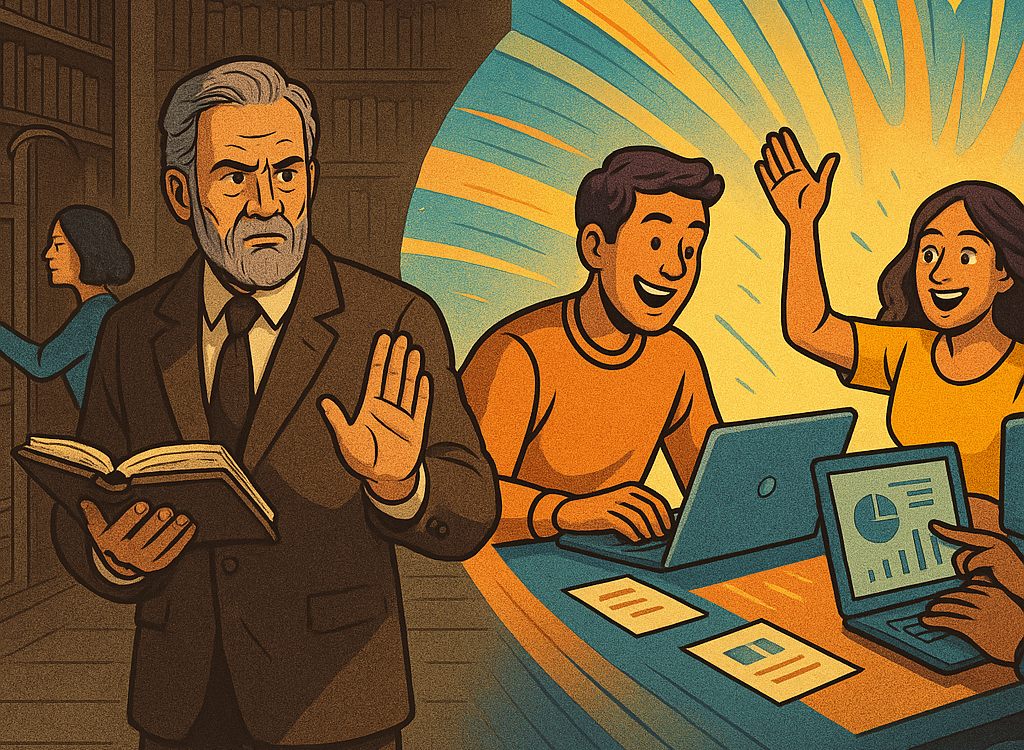
Imagine waking up tomorrow and discovering that intelligence — once the rarest and most expensive resource on earth — is suddenly free. Everywhere. In every hand.
That’s not science fiction. That’s today.
For most of human history, specialized knowledge was scarce.
- Advanced education was reserved for a privileged few, with universities and guilds tightly controlling access.
- Expertise required decades of training and costly credentialing.
- Even in recent decades, deep intelligence was treated like a luxury good. Consultants charged millions for insight. Market data sat behind Bloomberg Terminals costing thousands per seat. Knowledge was rationed by price and access.
That world is gone.
Ethan Mollick calls this new reality Mass Intelligence. As he puts it:
“Every institution we have — schools, hospitals, courts, companies, governments — was built for a world where intelligence was scarce and expensive. Now every profession, every institution, every community has to figure out how to thrive with Mass Intelligence.”
You can’t manage your way through this. You can’t hide behind policies or bolt AI onto outdated processes.
Mass Intelligence is here. Denial is not a strategy.
The bottleneck isn’t access anymore. The bottleneck is leadership.
Why This Moment Matters
For centuries, organizations were built on the assumption that knowledge was scarce.
That’s why hierarchies put a small number of decision-makers at the top. That’s why credentials became gatekeepers for who was “qualified” to weigh in. That’s why rigid approval processes slowed everything down — decisions could only move forward once the few with access to expertise signed off.
In a scarcity era, those systems made sense. But in a world of abundant intelligence, they turn into bottlenecks. They stifle creativity. They frustrate employees who know they can get answers in seconds while the system demands weeks.
Think about a marketing team that drafts an AI-powered campaign in a single afternoon — only to wait three weeks for approvals from layers of managers who don’t even understand how the tools work. By the time the campaign gets the green light, the moment has passed and the opportunity is gone.
Or picture an HR manager who uses AI to analyze exit interviews and spot a turnover trend in a matter of hours. Instead of acting quickly to fix the problem, the insight sits buried in a report until the next quarterly review — when the best people have already walked out the door.
This is the turning point: leaders must decide whether to cling to scarcity-era structures or lead their people into abundance.
The Role of Change Leadership
Change management focuses on adoption checklists and tool rollouts. That won’t cut it.
Change leadership means guiding people through ambiguity, not just enforcing compliance. It means creating the conditions for employees to experiment, share ideas, and bring AI-augmented intelligence into the work.
Experts don’t disappear. They evolve.
- A doctor won’t compete with AI on diagnostics — but they will help patients understand the results, weigh risks, and make human-centered choices.
- A lawyer won’t be valued for writing contracts faster than AI — but for interpreting nuances, anticipating human behavior, and advising clients on strategy.
- A marketing strategist won’t “beat” AI at generating ideas — but will curate, refine, and align those ideas with brand, culture, and market timing.
In other words, expertise shifts from having the most answers to asking the right questions, validating outputs, and applying judgment in context.
Their role becomes not just about knowledge, but about trust — guiding teams and organizations to make sense of abundant information, filter signal from noise, and move forward with confidence.
The Human Factor
This isn’t just a technology challenge. It’s a culture challenge.
Fear is natural:
- Fear of being replaced.
- Fear of too much input, too fast.
- Fear of not knowing what to trust.
When leaders ignore those fears, disengagement grows.
But the danger goes beyond disengagement. Too many companies are making reactionary cuts, assuming automation can fully replace people. Then, months later, they realize the role was more complex than a workflow. Suddenly, they’re scrambling to rehire for positions they never should have eliminated — paying double in recruiting costs, retraining, and lost productivity.
Our Turnover Cost Calculator shows just how expensive those missteps can be. What looks like a cost savings in the short term can end up draining resources and momentum when you factor in the price of rehiring, onboarding, and lost institutional knowledge.
The real leadership challenge is this: helping people see how much they are still valued, even in an era of Mass Intelligence. AI can accelerate tasks, but humans bring context, creativity, and empathy — the very things that build trust with customers and teams.
Leaders must:
- Name the fear out loud so people know it’s safe to talk about.
- Reinforce value by showing where human judgment, creativity, and relationships can’t be automated.
- Invest in people with training and opportunities to use AI as a partner, not a competitor.
When employees feel they are valued partners in this transformation, they lean in. When they don’t, they walk away — and the cost of replacing them is far higher than the cost of helping them adapt.
👉 Mass Intelligence doesn’t make people obsolete. It makes valuing people a leadership imperative.
If intelligence is everywhere, the differentiator is no longer knowledge. It’s courage. It’s creativity. It’s leadership.
The companies that thrive won’t be the ones clinging to rigid hierarchies. They’ll be the ones that trust their people to step up, use these tools, and contribute in ways they never could before.
👉 Mass Intelligence proves the problem isn’t capability — it’s alignment and leadership.
The Leadership Imperative
Mass Intelligence is not a trend. It’s a tidal wave.
You can try to manage it. You can try to ignore it. But denial is not a strategy.
The only choice is to lead.
And the leaders who do? They’ll unlock a future where people and AI work together to do things we once thought impossible.