
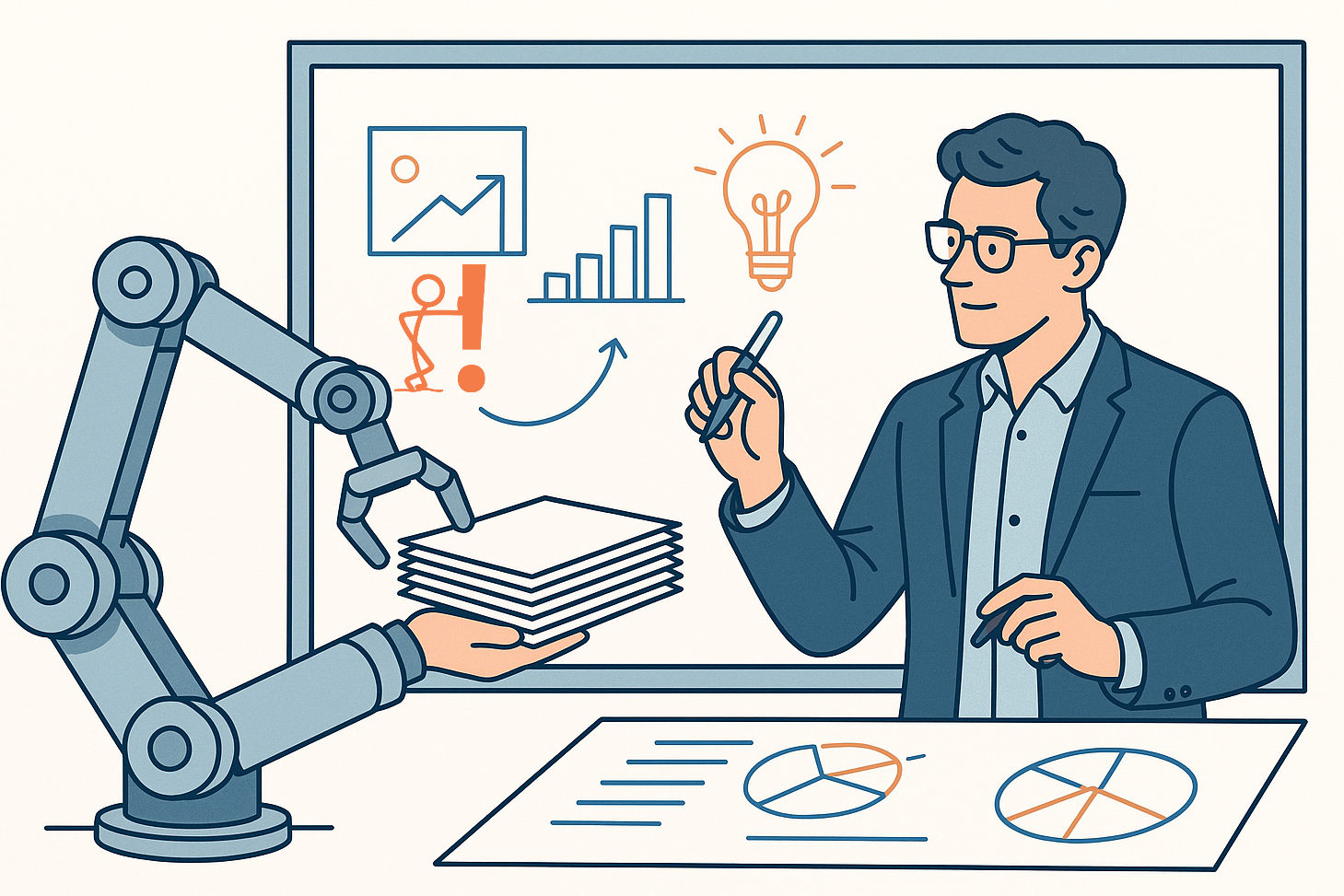
Most organizations are approaching AI with the same thinking they applied to every other business tool: how do we get more done, faster? But AI is More Than a Productivity Tool.
When applied with vision, it doesn’t just streamline existing processes; it can reveal new possibilities. It doesn’t just save time; it should challenge how time should be used.
Efficiency is not the goal. It’s the baseline.
AI offers the rare opportunity to rethink how value is created, how people grow, and what an organization is even for in the first place. Is it:
- Is it a machine for output?
- A platform for human growth?
- A network of problem solvers?
- A learning organism?
AI makes these questions relevant again. Because if we’re no longer bound by the constraints that shaped the old answers, we get to define new ones.
The mistake many companies are making is viewing AI as an IT upgrade, something for operations to handle, or for marketing to speed up content production. But the real question isn’t how to make existing work faster. It’s what new things we can do now that weren’t possible before.
When leaders keep their focus on productivity alone, they miss the deeper opportunity: reinvention.
“The most valuable businesses of the coming decades will be built by entrepreneurs who seek to empower people rather than make them obsolete.” — Peter Thiel
Moving from Execution to Innovation
The conversation around AI often centers on automation and job displacement. But a more useful frame is expansion. When AI takes on routine, time-consuming tasks, people are freed up to do more strategic, creative, and human-centered work. The bandwidth AI creates can be used to think more boldly, experiment more freely, and solve more complex problems.
According to the World Economic Forum, AI is expected to disrupt 85 million jobs by 2025—but also create 97 million new ones in emerging fields and roles.
This shift is already happening. Forward-thinking companies are using AI to explore new markets, design more inclusive services, and involve more employees in innovation. They’re not just reducing time-to-output, they’re increasing the quality of what gets built, and who gets to build it.
That requires a new mindset. One where creativity, curiosity, and collaborative problem-solving are no longer optional. AI moves us from a compliance economy to a creativity economy. And that changes everything about how we hire, train, lead, and reward.
Organizations that embrace this shift empower their teams to move from execution to invention. AI isn’t replacing people—it’s amplifying their potential. But only in cultures that know how to use it well.
“Generative AI is not a replacement for human creativity, but a tool that can augment and enhance it.” — Sam Altman, CEO of OpenAI
Empowering Individuals with Scalable Capability
One of the most powerful aspects of AI is how it redistributes capability. What once required a full team or a dedicated department is now possible for an individual with the right tools. Access has been radically expanded.
The practical outcome is that power and creativity are becoming decentralized. A junior marketer can generate a strategic campaign. A customer service rep can analyze sentiment data and identify trends. A founder can build a company from their laptop.
This isn’t just about doing more with less. It’s about enabling more people to contribute in more meaningful ways. That’s the future of work. And it’s already here.
“AI is the greatest technology equalizer of all time.” — Jensen Huang, CEO of Nvidia
To succeed in this environment, organizations must move away from rigid hierarchies and slow approval processes. They must cultivate a culture of trust, experimentation, and initiative. When people are trusted to use AI tools thoughtfully and creatively, the organization becomes more agile, more inclusive, and more capable of solving hard problems.
The Cultural Barrier to Adoption
Despite the opportunity, many organizations are still hesitating. Not because the tools aren’t ready, but because their culture isn’t. People are unsure how AI will affect their jobs. Managers are unsure how to measure impact. Executives are unsure how to align AI efforts with business strategy.
A Gallup poll from 2024 found that only 1 in 6 American workers regularly use AI in their job, despite the rapid availability of tools.
Adoption doesn’t begin with software. It begins with leadership.
Leaders must clearly define what success looks like in an AI-enabled organization. They must invest in learning, create psychological safety, and be willing to evolve legacy processes. They must encourage teams to experiment, fail, and learn.
AI mirrors the culture it enters. A culture that punishes mistakes will see cautious, limited use. A culture that rewards exploration will see breakthroughs.
“AI may rival or even surpass human creativity, but it lacks the ethical grounding that guides human behavior.” — Pavel Durov, Founder of Telegram
The role of leadership isn’t to control AI adoption. It’s to design the conditions where good decisions and great ideas can emerge.
AI as a Strategic Lever for Business Reinvention
We are at an inflection point. AI is not just changing how we work; it’s changing what we value in the workplace. Organizations that treat it as a tactical tool will get tactical results. Organizations that treat it as a strategic catalyst will unlock a new era of innovation, engagement, and impact.
At Amplified Concepts, we help leaders and teams build the mindset, systems, and culture to make that shift. We provide the frameworks, training, and support to navigate change and amplify potential.
If you’re ready to redesign how your business works, grows, and leads in the age of AI, we’d love to talk.
Contact us: sherry@amplifiedconcepts.com Or take the first step at amplifiedconcepts.com/letsgetstarted