
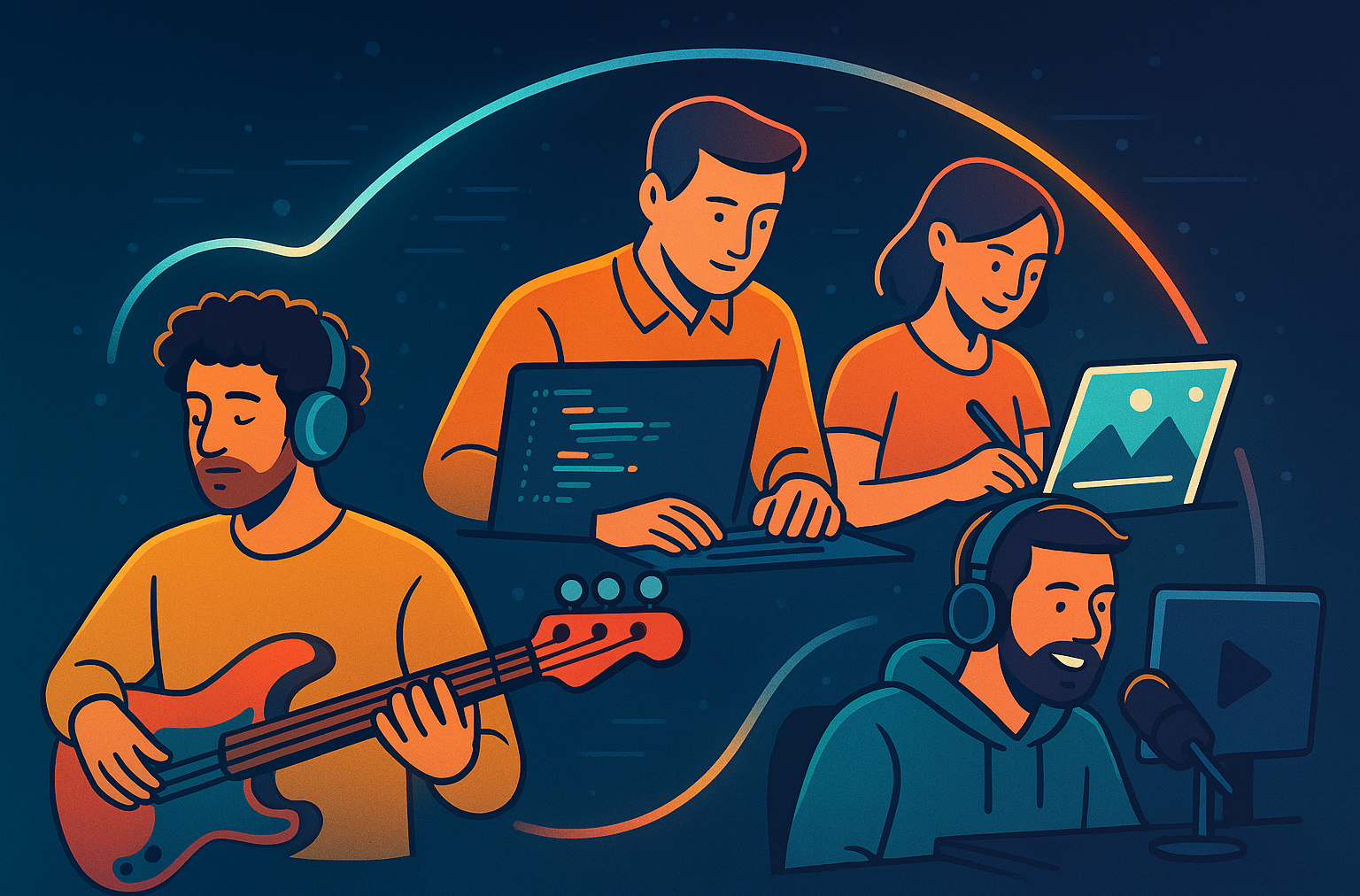
In 2006, the internet felt wide open. For the first time, regular people could reach an audience without going through a publisher, a record label, or a TV network. It was exciting, It was empowering. It was a little anxiety-inducing.
If everyone had access to distribution channels, wasn’t it going to get a bit noisy? Wouldn’t it become way more competitive? How could a person stand out and make their mark?
As I played with ChatGPT 5 this weekend and created a simple app, a similar anxiety hit me. If everyone has access to these tools, won’t things get really noisy? Competitive? How will I stand out?
In 2006, Chris Anderson’s The Long Tail predicted that the future of business would be “selling less of more,” meaning the small, niche products ignored by big box stores could, in aggregate, rival the sales of blockbusters. Nearly twenty years later, the proof is everywhere. Funk band Vulfpeck built a global audience without a label, selling out Madison Square Garden in 2019 purely through direct-to-fan online distribution. Andy Weir’s The Martian began as a self-published science fiction serial on his website and Kindle Direct Publishing, found a devoted niche of space enthusiasts, and became a Hollywood movie. Entire industries like podcasting, live streaming, and influencer marketing did not just benefit from the Long Tail; they were born from it, thriving on millions of small, dedicated audiences.
Now, the curve is bending again. With AI capable of creating niche products, services, and experiences instantly, it’s time to revisit the Long Tail, but this time expect the opportunities to be faster, sharper, and more personal than anything we saw in Web 2.0.
Why AI Changes Everything
Back in the early days, the hard part was making a niche product accessible. You still had to make it yourself, whether it was an indie film, a handmade product, or a self-published book, and that took time, money, and risk.
Now, with generative AI — and especially ChatGPT 5’s ability to code, generate designs, and integrate with other tools — the economics and mechanics change completely:
- No need for pre-existing products: The “tail” is no longer a warehouse full of niche items waiting for a buyer. It’s an engine that can produce whatever the buyer wants, exactly when they want it.
- Real-time, one-to-one creation: You can create something only once for a single customer without worrying about whether there’s a mass market for it. That makes even ultra-niche ideas profitable because they require no upfront investment.
- Personalization as the default: Instead of selling the same product to many people, you can generate a slightly different, perfectly tailored version for each person.
- Compressed production timelines: What used to take months and multiple departments (coding, design, marketing, prototyping) can now be done in hours or days by one person leveraging AI.
This is why “bringing it to life on demand” is such a big leap. In the original Long Tail, you could access niche things you didn’t know existed. In Long Tail 2.0, the niche thing you want might not exist until the moment you ask for it — and then it exists just for you.
Who’s About to Win Big
Small businesses and entrepreneurs are entering the most level playing field we have ever seen. You no longer need a big budget to compete; you need creativity, speed, and the courage to experiment. The companies that can spot a niche, build for it in days, and serve customers so specifically that it feels personal will own the future.
Creative professionals who lean in will thrive too. Those who treat AI as a partner will multiply their output and precision, reaching audiences they never thought possible. Once you build trust and loyalty, those audiences will follow you wherever you go.
Who’s at Risk
Big, slow-moving companies face a serious challenge. Economies of scale mean less when every customer can have their own version of a product. Brand dominance loses its edge when personalization wins hearts and minds. And bureaucracy is deadly when your competitors can go from idea to market before your meeting agenda is even approved.
Individuals who stay on the sidelines are also at risk. Skills that can be easily replicated by AI will lose their premium value. Without building a personal brand or audience, it’s easy to disappear into the noise of an infinite marketplace.
What You Can Do Right Now
If you run a business, start experimenting without fear. Test small ideas quickly and see what sticks. Loosen the reins so your team has the freedom to move fast without getting bogged down in red tape. Build systems that make it easy to personalize products and services for different audiences without starting from scratch each time.
If you’re an individual, make AI your creative partner so you can produce more, faster, and better. Focus on owning your audience by building direct relationships that aren’t dependent on algorithms. And always lead with what makes you human — your perspective, your lived experience, your stories — because those are the elements AI can’t replicate.
The first Long Tail wave proved that niche markets could thrive without being overshadowed by big brands. This time, the tail isn’t just long. It’s alive. It can collaborate, adapt, and create in real time.
The winners won’t be the ones with the biggest budgets or the most followers. The winners will be the ones who see the opportunity, imagine the niche, and bring it to life before anyone else even realizes it’s possible.